The Model Minority
Why do we underestimate the significance of culture? It's what makes us human.

Amanda Ripley’s book, The Smartest Kids in the World, examines the education systems of South Korea, Finland and Poland. Though it seeks to compare and contrast the students and schools of these countries to those in America, I was reading because I was primarily interested in understanding how South Korea breeds such high-achieving and disciplined children and if there was anything to be said about Korean-American children and their success.
South Korean children spend their days either in school or at private tutoring academies. The education system is actually remarkably inefficient— Ripley relays reports of children falling asleep at their desks or blatantly not paying attention at school. We all know we can only be productive for a certain number of hours each day, and these students determined that tutoring provides more educational value than class so they save their energy for the former mode of learning. So what’s the secret?
Culture.
Education is a fundamental value in South Korea and all members of the system are dedicated to the prioritization of academics. Notably, parents in this country are active participants in their child’s educational journey, striving to secure admission to hagwons with the expectation of achieving high standardized test scores in return. The championing of academic performance and devotion to one’s studies is foundational to Korean culture and can partially explain why Koreans in America are also perceived to be successful. However, acknowledging this also delegitimizes our discrimination and allows others to weaponize the concept of the American Dream.
The model minority myth is rooted in prejudice; there is no biological evidence that Asians are inherently more intelligent than other races or that Blacks have more athletic ability, though many white supremacists and racists attempt to use science to justify their arguments for inequality. It shouldn’t come as a surprise that these same people argue Asians can benefit from these generalizations. As with most stereotypes, we can look back to slavery and genocide to understand where these beliefs are rooted: this timeline traces back the model minority myth to World War II and provides a helpful illustration of its development.
I distinctly remember sitting down for dinner with my high school friend and her dad. My friend had already committed to a school for rowing and we had just finished college applications and came to the city to celebrate. As we were waiting for dessert, her dad asked me why I didn’t end up going to school for soccer. “Aren’t you people supposed to be overachievers?”
If you know me well, you are aware of how much self control I had to exhibit in that moment. I’m not afraid of confrontation nor am I afraid of a good debate, but I bit my tongue. I knew he didn’t mean to be offensive but I couldn’t help but feel both disrespected and misunderstood. The reality is the model minority myth not only harms Asians but many other groups, especially Blacks, who are wrongfully characterized as the opposite of a “model” minority; this often results in minorities being pitted against one another, dividing our society even further.
After that dinner, I came home and opened my computer. I browsed through the mp4 files in my “soccer videos” folder, watching myself score goals and deliver graceful crosses, asking myself why I decided not to send them to the college coaches attending my club team games. The model minority myth does exactly this; it neglects the diversity of the individual human experience— it makes you question who you are.
I wasn’t born with any expectations of who I should or shouldn’t be. I grew up and realized that who people expected me to be was not always who I wanted to be, and that for some reason people expected me to be bad at sports, and that those people continued to cling to that expectation, even when I was made captain. I grew up and noticed for the first time that I was the only Asian girl on the team, and maybe I should have said this all to my friend’s dad just to see what he would have to say on the matter.
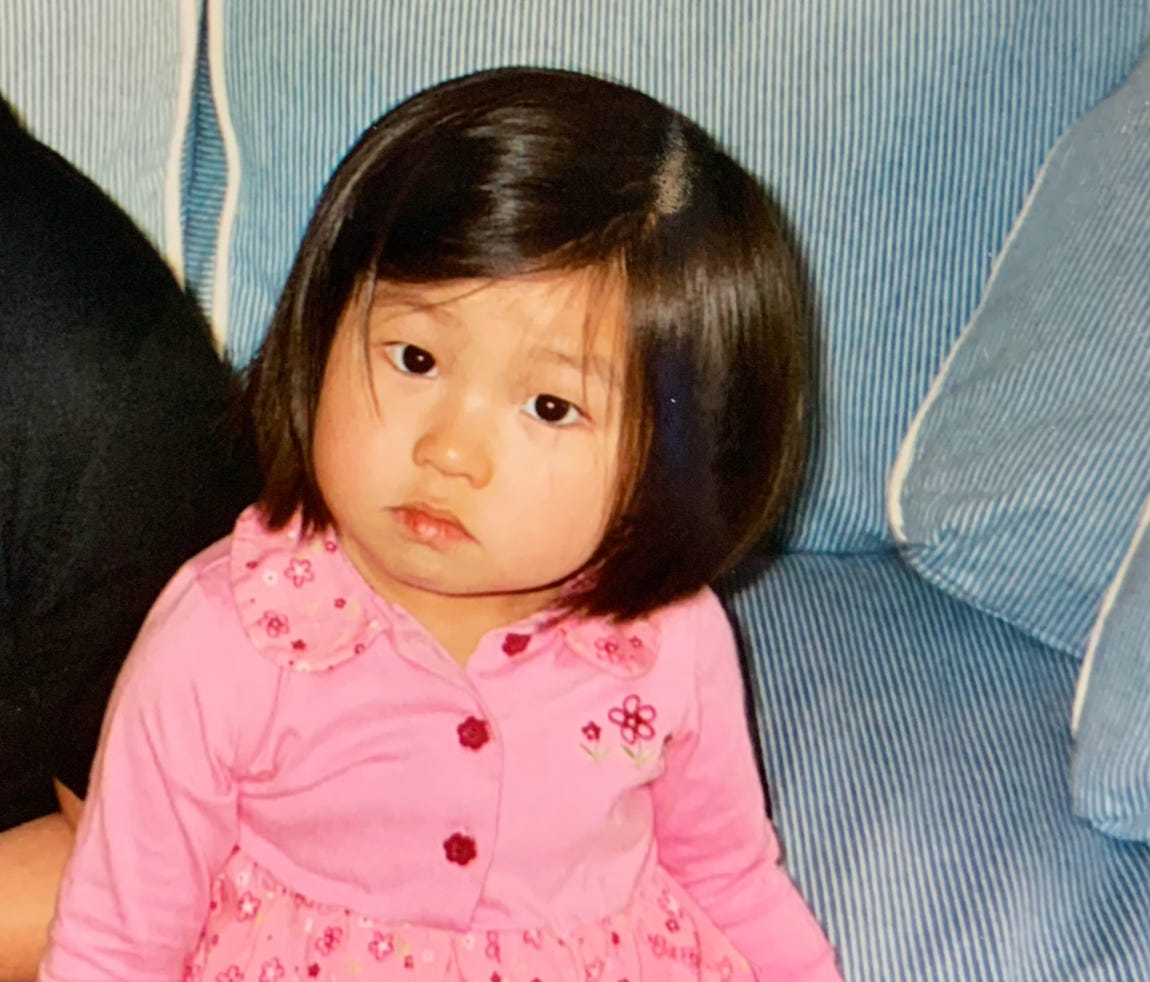
You may be glad to know I grew up to be fearlessly self-assured; in fact, I was all along. The kid in the above photo didn’t let anyone step on her toes.
Yuval Noah Harari, author of Sapiens, argues that the human ability to share belief systems and essentially create “culture” and imagined societal structures is what separates us from other animals on earth. We tend to underestimate the influence of our beliefs and how they can simultaneously shape an individual and also perpetuate stereotypes surrounding a group of people. There is so much fascinating research and literature about the evolution of culture in human history and there is so much more to say about the model minority myth, but I want to end with this: if we reframe our thinking and remember that society is formed by imaginary frameworks, we take back our power to choose our own identities, and that is a beautiful thing.
With love,
Emma